
In July 1944, in Bretton Woods, USA, representatives from 44 countries came together to lay the foundations for a new global financial system. Out of this conference were born two institutions that would dominate the economic world for the next eight decades: the International Monetary Fund (IMF) and the International Bank for Reconstruction and Development (IBRD) - the nucleus of what we know today as the World Bank.
The stated aims of these institutions were noble: monetary stability, international cooperation and rebuilding the world after the devastation of the Second World War. As the decades passed, however, the original intentions were distorted by the geopolitical and economic interests of the great powers, transforming what was meant to be a supportive instrument into a global economic control mechanism.
The origin and structure of the World Bank
The World Bank was conceived as a lending institution for the reconstruction of post-war Europe. But very soon, with the launch of the Marshall Plan and the consolidation of American hegemony, its role shifted to developing countries - providing them with financing conditional on economic policies dictated by its main creditors.
In its system, voting power is directly proportional to financial contribution - meaning that rich countries decide and poor countries follow. The United States has held and continues to hold veto power in major decisions, making the World Bank a tool of the Western economic agenda.
In the 1980s and 1990s, under the guise of "structural reforms", thousands of countries were forced to adopt austerity policies, massive privatizations, wage cuts and cuts in education and health - all to "balance" their balances of payments. In reality, these measures have created a new kind of dependency, a financial colonization in which people become prisoners of perpetual debt.
Doubts and documented effects
- Internal World Bank reports (such as the World Development Reports from 1981-2000) recognize that reforms imposed in Africa and Latin America have increased poverty rather than reduced it.
- Indian economists such as Joseph Stiglitz, former vice-president of the World Bank, have publicly denounced "aid" mechanisms that in fact conceal an architecture of financial domination.
- Failed projects - dams, mines, deforestation - have left millions displaced and irreversible environmental destruction confirmed in the World Bank's own Environmental Assessment Reports.
- IMF and World Bank conditionality is systematically correlated with declining living standards and loss of economic sovereignty - a reality confirmed by the UNDP Human Development Reports.
Symbol of an era that is over
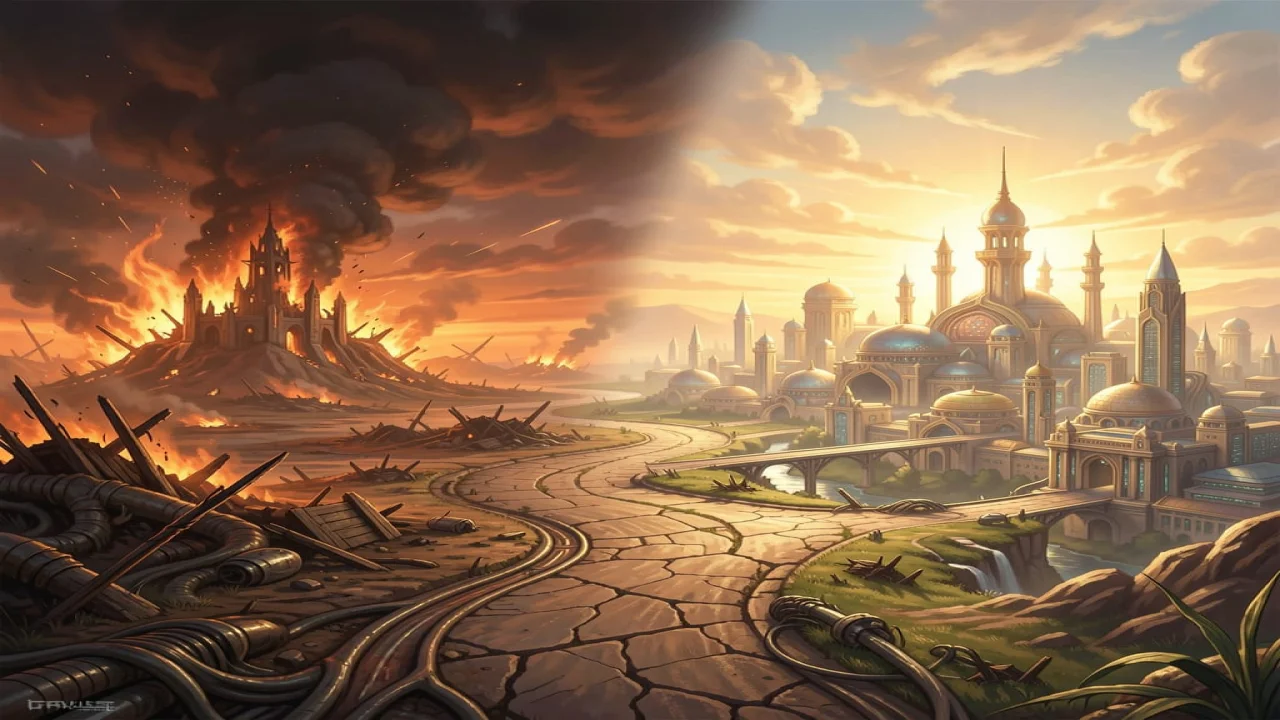
From an instrument designed to rebuild, the World Bank has become a symbol of imbalance. Bretton Woods - the laboratory where the financial architectures of the industrial age were designed - is now a thing of the past. What was once an alliance for cooperation has morphed into a system of planetary debt management in which money no longer serves life, but control.
Today, at the dawn of a new era - the Great New Year - these institutions can no longer sustain the vibration of a rising planetary consciousness. They represent the legacy of a dark system, built on the night of the Great Year, in which the value of life has been reduced to numbers and abundance has been replaced by the fear of scarcity.
A new beginning for the economy of consciousness
What follows is not just the end of an institution, but the closing of a global karmic cycle. The lessons created by these structures - economic domination, the illusion of infinite growth, monetary manipulation - are part of the learning process of a civilization that is now rediscovering the sacredness of balance.
In the new architecture of the world, trade will be based on abundance, cooperation and respect for life. There will be no need to borrow, for the planet's primary resource is Consciousness itself - and it is inexhaustible.
This creation on the night of the Great Year does not serve the Whole, nor humanity, and is a block in the way of humanity's evolution, in the way of Life and Peace on Earth. Such groups cannot serve on Great Year's Eve, and the members of this organization are accountable for their lessons - monetary manipulation, exploitation of the Whole - another planetary example of group lessons within this Planetary School.
A lesson that requires paying the bill created on Great Year's Eve to the Whole - represented by this Planetary School of Consciousness, which has been manipulated by the ravings of criminal groups formed in the dark ages.
The World Bank can no longer serve any purpose on the Great Year's Day, because of the lessons it has generated during the night of the Great Year - lessons that do not bring this group into the Light, but mark the end of its cycle within this Planetary School.
The World Bank offers "development" with conditions that exploit countries:
**Control of natural resources** - exploitation of poor countries
**Control of infrastructure** - exploitation of poor countries
**Control of education** - control of consciousness
**Control of health** - control of population
The World Bank adopts programs that are never implemented correctly: **Nigeria (1986-2000)** - oil exploitation, impoverishment of population
**Ghana (1983-2000)** - gold exploitation, impoverishment of the population
**Kenya (1993-2000)** - resource exploitation, impoverishment of population
**Zambia (1991-2000)** - copper exploitation, impoverishment of population
**Tanzania (1986-2000)** - resource exploitation, impoverishment of population
**Uganda (1987-2000)** - resource exploitation, impoverishment of population
**Brazil (1998-2002)** - exploitation of resources, impoverishment of population
**Mexico (1995)** - exploitation of resources, impoverishment of population
**Argentina (2001)** - exploitation of resources, impoverishment of population
**Chile (1982)** - resource exploitation, population impoverishment
**Peru (1990-2000)** - resource exploitation, impoverishment of population
**Ecuador (2000)** - resource exploitation, population impoverishment
**Indonesia (1997-2003)** - exploitation of resources, impoverishment of population
**Thailand (1997-2003)** - resource exploitation, impoverishment of population
**South Korea (1997-2001)** - exploitation of resources, impoverishment of population
**Philippines (1983-2000)** - resource exploitation, impoverishment of population
**Pakistan (2008-present)** - resource exploitation, population impoverishment
**Ukraine (2014-present)** - exploitation of resources, impoverishment of population
**Moldova (2009-present)** - exploitation of resources, impoverishment of population
**Georgia (2008-2012)** - resource exploitation, population impoverishment
**Armenia (1995-2000)** - resource exploitation, population impoverishment
Editorial Notes:
This article is a living document currently in development. While automated translation provides accessibility, nuanced concepts may require consultation of the original Romanian/ Dacian version for full philosophical precision.


Most Commented Audit of creation
The end of the G7 Great Powers Club
The Group of 7 (G7) was created in 1975, not for democracy, but for elitist global control, unaware that from so many elites there are planetary examples of the entrance of the big day. ...